ACCESS & DIGNITY
How Karen Gaal turned a neighborhood accessibility problem into a disability-rights campaign—and demonstrated how community experience can become systems change.
What happens when a community problem is not actually one problem?
Effective leadership requires more than responding to what is immediately visible.
It requires understanding the systems underneath the problem, separating distinct barriers,
building the right partnerships, and developing solutions capable of lasting beyond a single intervention.
Access & Dignity
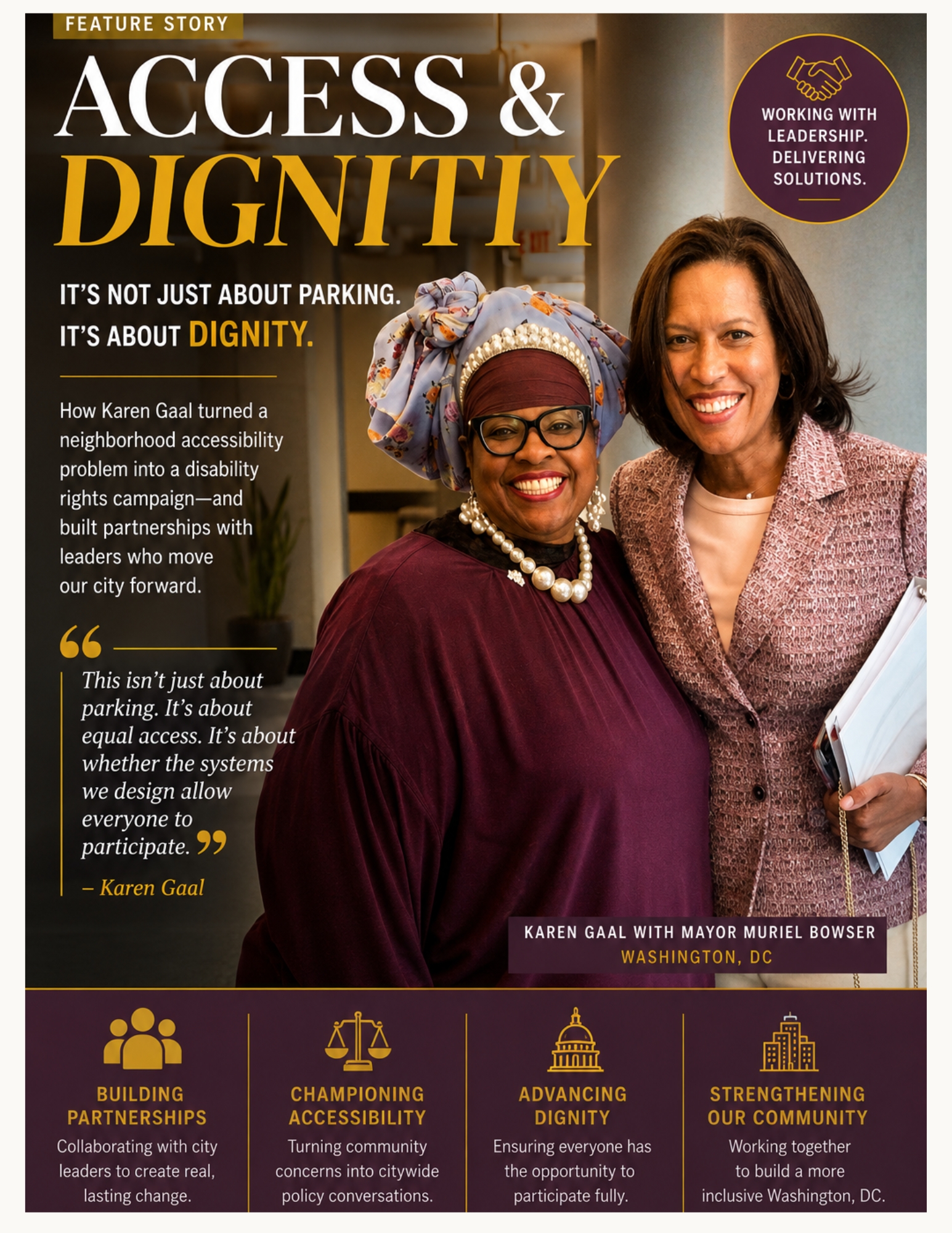
A Karen Gaal Institute Leadership in Action feature examining disability rights,
accessibility, civic leadership and systems change in Washington, DC.
It Began With Listening.
Karen Gaal began hearing from Washington, DC residents with disabilities who were
navigating significant distances between available parking and their homes.
Their experiences included physical strain, falls, difficulty reaching medical appointments
and barriers to everyday independence.
Further examination revealed a deeper structural issue: some residents were not simply
struggling to obtain reserved disability parking. They faced eligibility barriers connected
to the type of housing in which they lived.
What initially appeared to be a parking problem therefore raised larger questions about
access, eligibility, infrastructure, equity, public policy and human dignity.
One Concern. Two Distinct Problems.
The deeper Karen examined the issue, the clearer the diagnosis became.
Treating everything as one problem risked weakening the solution.
One issue concerned who could seek an accommodation.
The second concerned whether enough accessible infrastructure existed
in residential neighborhoods in the first place.
That led to a fundamental KGI leadership principle:
Different problems require different solutions.
“This isn’t just about parking. It’s about dignity. It’s about equal access.
It’s about whether the systems we design allow everyone to participate.”
— Karen Gaal
A Two-Track Systems Response
Rather than force interconnected problems into one intervention,
Karen developed separate pathways addressing both access to accommodation
and the availability of accessible infrastructure.
Track One
Eligibility & Equal Access
Examine who is permitted to seek an accommodation, whether a regulatory structure
produces unequal treatment, and how systems can be redesigned around documented
need rather than housing type.
Track Two
Accessible Infrastructure
Examine whether neighborhoods have sufficient accessible parking infrastructure
and pursue broader residential accessibility solutions serving residents,
visitors, seniors and people with disabilities.
From Lived Experience to Systems Change
The case illustrates a repeatable leadership process for moving from community
concern toward structural solutions.
Listen
Begin with lived experience and understand how the issue affects real people.
Investigate
Study the policies, agencies, regulations, processes and decision-making structures.
Diagnose
Determine whether one visible problem actually contains several different barriers.
Design
Create focused solutions appropriate to each identified problem.
Convene
Bring residents, agencies, institutions and community stakeholders into the work.
Advance
Move concern toward policy, accountability, infrastructure and lasting systems change.
From Community Experience to Decision-Making Rooms
Effective systems change requires the ability to move between different rooms
without losing sight of the people affected by the problem.
Karen’s work regularly places her at the intersection of residents, community
organizations, agency professionals, business leaders and senior government leadership.
The objective is not access for access’s sake.
The objective is converting access into understanding, partnership,
accountability and solutions.
Strategic Presence
Leadership requires understanding which rooms matter, why they matter,
and how to connect the people experiencing a problem with those capable
of helping change the surrounding system.
Presence → Relationship → Trust → Partnership → Institutional Change
This Isn’t Just About Parking. It’s About Dignity.
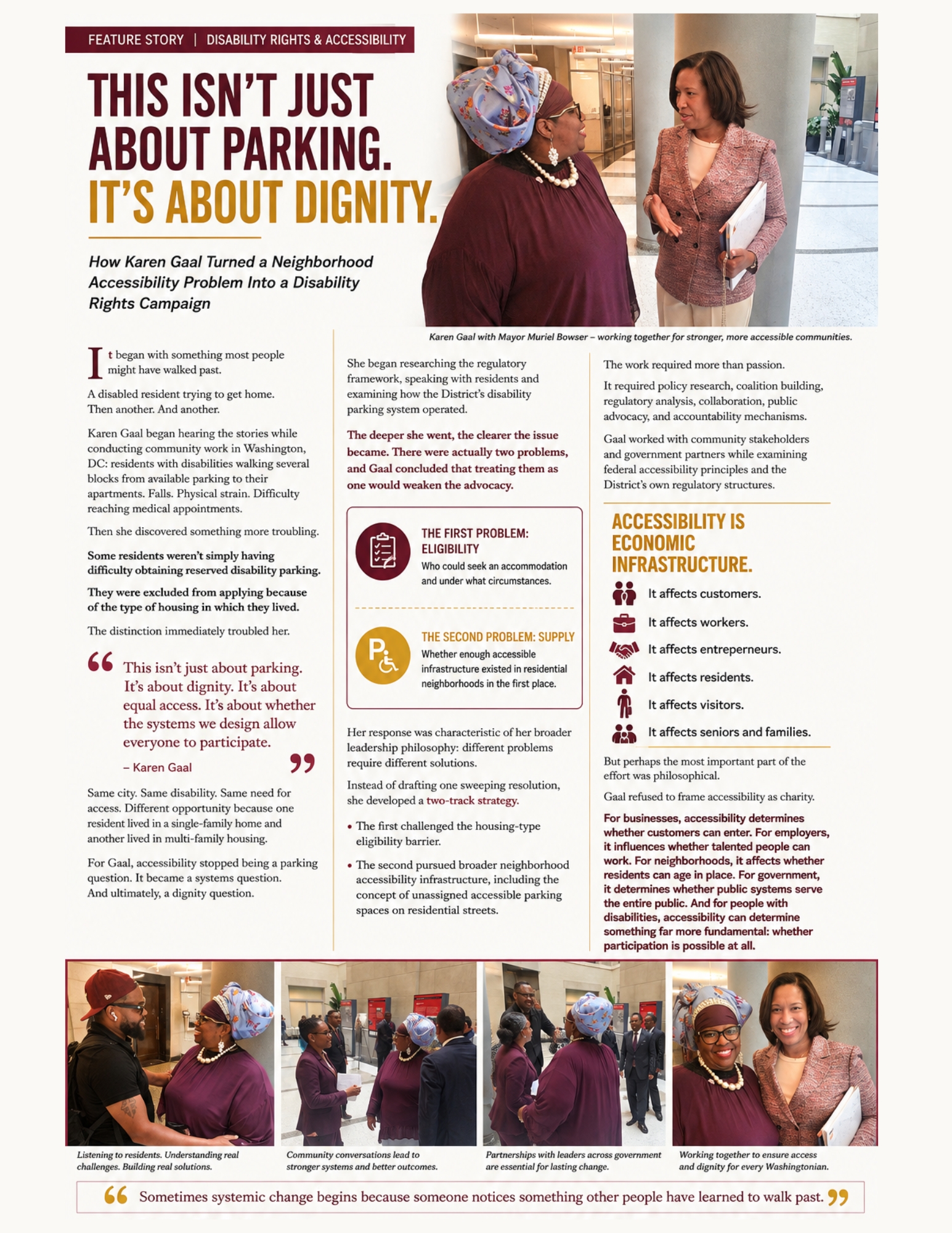
community listening and the relationship between accessibility,
dignity and economic participation.
Accessibility Is Economic Infrastructure.
Accessibility is not solely a disability-policy issue.
It affects whether people can participate in the economic,
professional, civic and social life of a city.
Customers
Can customers reach, enter and use businesses?
Employees
Can talented people participate fully in the workforce?
Entrepreneurs
Can people independently participate in commerce and enterprise?
Residents
Can residents remain mobile, connected and independent?
Seniors & Families
Do neighborhood systems support aging in place and caregiving?
Government
Are public systems designed so the whole public can participate?
This Isn’t Just About Parking. It’s About Dignity.
How Karen Gaal Turned a Neighborhood Accessibility Problem Into a Disability Rights Campaign
It began with something most people might have walked past.
A disabled resident trying to get home.
Then another. And another.
Karen Gaal began hearing the stories while conducting community work in Washington, DC:
residents with disabilities walking several blocks from available parking to their apartments.
Falls. Physical strain. Difficulty reaching medical appointments.
Then she discovered something more troubling.
Some residents weren’t simply having difficulty obtaining reserved disability parking.
They were excluded from applying because of the type of housing in which they lived.
Same city. Same disability. Same need for access.
Different opportunity because one resident lived in a single-family home and another
lived in multi-family housing.
For Gaal, accessibility stopped being a parking question.
It became a systems question. And ultimately, a dignity question.
She began researching the regulatory framework, speaking with residents and examining
how the District’s disability parking system operated.
The deeper she went, the clearer the issue became.
There were actually two problems, and treating them as one
risked weakening the advocacy.
The first concerned eligibility.
The second concerned supply.
One required examining who could seek an accommodation.
The other required examining whether enough accessible infrastructure existed
in residential neighborhoods in the first place.
Her response reflected a broader leadership principle:
different problems require different solutions.
Instead of drafting one sweeping resolution, she developed a two-track strategy.
One challenged the housing-type eligibility barrier.
The other pursued broader neighborhood accessibility infrastructure,
including the concept of unassigned accessible parking spaces on residential streets.
The work required policy research, coalition building, regulatory analysis,
collaboration, public advocacy and accountability mechanisms.
“This isn’t just about parking. It’s about dignity. It’s about equal access.
It’s about whether the systems we design allow everyone to participate.”
— Karen Gaal
For businesses, accessibility determines whether customers can enter.
For employers, it influences whether talented people can work.
For neighborhoods, it affects whether residents can age in place.
For government, it determines whether public systems serve the entire public.
And for people with disabilities, accessibility can determine something much more fundamental:
whether participation is possible at all.
Accessibility is not simply a regulatory requirement to satisfy after everything else
has been designed.
It is economic infrastructure.
Sometimes systemic change begins because someone notices something other people
have learned to walk past.
KGI Helps Leaders See the System Around the Problem.
The Karen Gaal Institute works with civic leaders, nonprofit executives,
public safety professionals and institutions to move beyond surface-level
problem solving and build strategies that strengthen people,
partnerships and systems.
Identify structural causes, gaps and decision points.
Build relationships across residents, institutions and leadership.
Translate lived experience into actionable information.
Convert community concerns into focused policy responses.
Examine whether systems allow everyone to participate.
Help leaders move intentionally from presence to impact.
Connect partners capable of moving systems forward together.
Develop structures and leaders capable of sustaining change.
Systems. Dignity. Capacity Building.
Sustainable change requires infrastructure that outlives individual intervention.
Systems without dignity become bureaucratic; dignity without systems becomes unsustainable.
The work is to build structures that protect people, expand participation and strengthen
the capacity of communities and institutions to respond long after the meeting ends.

